CLAS multistream transmission pattern ID
Introduction
Several corrections are noted below. Please also see CLAS multistream transmission facility ID.
The Quasi-Zenith Satellite System (QZSS), Michibiki, broadcasts not only positioning signals like GPS, but also augmentation signals to improve positioning accuracy. CLAS (Centimeter Level Augmentation Service) is one such augmentation signal specifically designed for high-precision positioning within Japan.
This document investigates the multi-streaming feature, one of the upcoming improvements to further enhance CLAS’s accuracy. It also reports the results of updating the augmentation information display tool QZS L6 Tool.
CLAS multistreaming
Currently, the following QZSS satellites are in operation:
- No. 2 (QZS2),
- No. 3 (QZS3),
- No. 4 (QZS4),
- No. 1 replacement (QZS1R),
- No. 6 (QZS6)
Of these, the same CLAS augmentation signal is being broadcast from four satellites, excluding QZS6.
In CLAS, Japan is divided into meshes, and large amounts of information such as ionospheric delay and tropospheric delay are created and transmitted for each positioning satellite and region. However, a challenge with CLAS is that the number of satellites that can be used for augmentation is limited to about 17.
To increase the number of satellites used for augmentation, more satellites were considered and divided into two groups, Pattern 1 and Pattern 2, with preparations underway to distribute and broadcast CLAS augmentation information via the Michibiki satellites. From June 30 to July 14, 2025, a test of this multi-streaming transmission was conducted using the QZS3 satellite. As of January 19, 2026, when the experiment period ended, the same CLAS augmentation information is being broadcast from the four Michibiki satellites mentioned above.
For this CLAS multistream transmission, the CLAS satellite signal specification (IS: interface specification) will change from the current IS-QZSS-L6-005 (issued 2022-09-21) to:
- IS-QZSS-L6-006 (issued 2025-01-21, discontinued),
- IS-QZSS-L6-007-Draft (issued 2025-06-??, discontinued),
- IS-QZSS-L6-007 (issued July 31, 2025),
This was updated in three parts. Here, we will read through the content.
In the currently valid IS-QZSS-L6-005, the CLAS augmentation information header is defined as shown in Table 4.1.2-2.
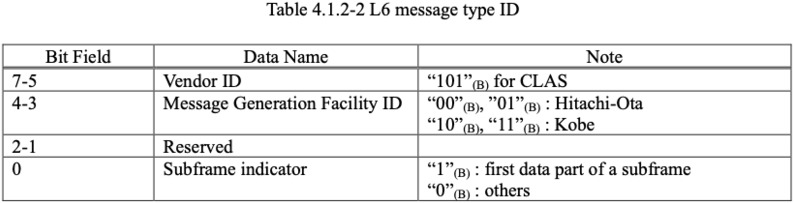
Both of these two reserved bits are assigned the value 1 0.(Correction, 2026-09-09) This means that the discussion of the correspondence between facility IDs and facility names, as well as the Python code below, contains errors.
The Michibiki control stations are located in:
- Hitachi-Ota City, Ibaraki Prefecture, and
- Kobe City, Hyogo Prefecture,
CLAS augmentation information is created in two sets at each location. For the Facility ID, the former has two sets of 00 and 01 assigned to these two bits, while the latter has two sets of 10 and 11 assigned to these two bits.
In IS-QZSS-L6-006, two broadcast patterns (Pattern 1 and Pattern 2) are now described in these two reserved bits.

In the current CLAS single-stream transmission, the value of these two bits is 11, allowing receivers to distinguish between conventional single-stream and multi-stream transmissions. The aforementioned test broadcasts with QZS3 appear to have been conducted with this two-bit value remaining at 11. (Correction, 2026-09-09)
On the other hand, in the seventh-version draft IS-QZSS-L6-007-Draft, released six months after the sixth-version, the control station names “Hitachiota” and “Kobe” disappeared, and they were replaced with Facility 1, 2, 3, and 4. Furthermore, the correspondence between the facility ID represented by these two bits and the facility number became dependent on the pattern number.
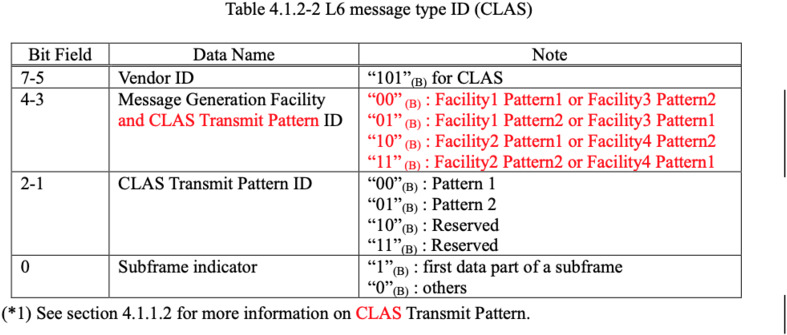
And in the 7th edition of the signal specification, IS-QZSS-L6-007, this notation was finalized.
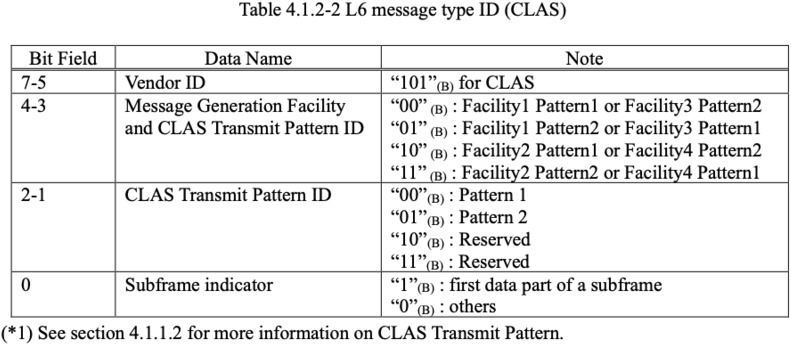
Correspondence between facility ID and facility name
While I personally find the removal of the control station name somewhat disappointing, I’ll try to imagine why it’s now represented by the Facility number.
Assuming that Facility 1 and 2 represent the Hitachiota station, and Facility 3 and 4 represent the Kobe station, then in the normal state, regarding the 3rd and 4th bits:
The Hitachiota station assigns 01 to QZS2 (Pattern 2 assignment), 00 to QZS4 (Pattern 1 assignment), 11 to QZS1R (Pattern 2 assignment), and 10 to QZS5 (Pattern 1).The Kobe station assigns 00 to QZS2, 01 to QZS4, 10 to QZS1R, and 11 to QZS5.
I believe this is intended to distribute the augmentation signal generation system between control stations and between pattern numbers, making it more robust against failures. (Correction, 2026-09-09)
Therefore, using the values from the 1st to the 4th bit, the QZS L6 Tool attempted to decode the pattern number and facility name as follows:
    self.patid  = self.mtid >> 2 & 0b11
    if self.patid == 0b10 or self.patid == 0b11:
        self.patid    = 0          # reserved pattern ID
        # self.facility = "Unknown"  # then, the facility is not defined
    else:
        self.patid  = (self.mtid >> 2) & 1 + 1  # ref.[7], CLAS pattern ID: 1 or 2, ref.[1] Table 4.1.2-2
        if (self.mtid >> 3) & 0b11 == 0b00:  # CLAS facility ID depends on pattern ID, very complex...
            if self.patid == 1:
                self.facility = "Hitachi-Ota:0"  # Facility 1
            elif self.patid == 2:
                self.facility = "Kobe:0"         # Facility 3
        elif (self.mtid >> 3) & 0b11 == 0b01:
            if self.patid == 2:
                self.facility = "Hitachi-Ota:0"  # Facility 1
            elif self.patid == 1:
                self.facility = "Kobe:0"         # Facility 3
        elif (self.mtid >> 3) & 0b11 == 0b10:
            if self.patid == 1:
                self.facility = "Hitachi-Ota:1"  # Facility 2
            elif self.patid == 2:
                self.facility = "Kobe:1"         # Facility 4
        elif (self.mtid >> 3) & 0b11 == 0b11:
            if self.patid == 2:
                self.facility = "Hitachi-Ota:1"  # Facility 2
            elif self.patid == 1:
                self.facility = "Kobe:1"         # Facility 4
I believe that one day we will see the answer to this. If the correspondence between this facility number and the control station name is incorrect, I will correct it immediately.
On December 22, 2025, the H3 rocket No. 8 and Michibiki No. 5 were lost, making it impossible to conduct demonstration experiments of ASNAV (Advanced Satellite Navigation system), a new technology for precise satellite coordinate identification in space.
This is very unfortunate, but I am very much looking forward to an exciting development that will turn this failure into a great success, such as the early return of the QZS5, the realization of ASNAV, and the implementation of amazing technologies like GPS Chimera (CHIp Message Robust Authentication).
Conclusion
I’ve been thinking about which control station creates the augmentation signals for the CLAS multi-streaming transmission of the Quasi-Zenith Satellite System (QZSS) Michibiki. I’ll continue to work hard writing code to keep up with Michibiki’s new technologies.
Related article(s):
- CLAS multistream transmission facility IDs and an update to QZS L6 Tool 15th September 2026
- Using QZS L6 Tool from Docker 29th May 2026
- CLAS multi-stream test broadcast 1st July 2025
- Display of MADOCA-PPP ionospheric delay information using QZS L6 Tool 16th August 2024
- QZS L6 Tool output format change 14th April 2024
- Health information expression for QZSS 7-satellite configuration 12th April 2024
- Galileo Timing Service Message 6th April 2024
- L1S signal analysis with QZS L6 Tool 11st November 2023
- Galileo HAS live stream 25th July 2023
- HAS message display capability on QZS L6 Tool 5th March 2023
- Trial delivery of QZSS's MADOCA-PPP started 18th August 2022
- Capacity analysis of CLAS satellite augmentation information using QZSS archive data 9th June 2022
- QZSS CLAS tropospheric delay augmentation information for remote islands in Japan 17th May 2022
- Compact SSR display capability on QZS L6 Tool 29th March 2022
- Release of QZS L6 Tool, a positioning satellite message display tool 3rd February 2022